This is hopefully the first of many articles in which I review hacking, programming, and other games that mostly involve in-game interaction with computers. There are a ton of these, from classics like Infocom’s Deadline and A Mind Forever Voyaging and Activision’s Hacker and Portal, all released in the early to mid 80s, SysOp and/or BBS hacking simulator door games I played on BBSes in the mid 90s, all the way to the crop of modern games meant to either leverage, or in many cases teach, coding and automation concepts in a “gamified” way. I hope to explore dozens of these games, but I’m starting off with a few that have been collecting dust in my backlog for ages.
Given my love for vintage computing, including the Commodore Amiga and the BBS scene, two topics both relevant to Digital: A Love Story, I’d been meaning to play this one since first hearing about it… which was like 15 years ago. 😒
So yeah, what I knew about DALS was that it was a narrative heavy game whose gameplay mostly involved calling various BBSes and reading and sending messages. What I didn’t know is that it is actually much more of a visual novel than any kind of simulation. In fact, it’s built on the well-known visual novel engine Ren’Py. Evidently a lot of cool trickery went into making this feel like more of an immersive, faux computing simulation though, as it’s reasonably effective at it. Of course, it’s far from perfect, but while a giant nerd like me could get all “ackchyually…” about dumb stuff like DTMF tone and modem handshake noise accuracy, there are bigger fish to fry.
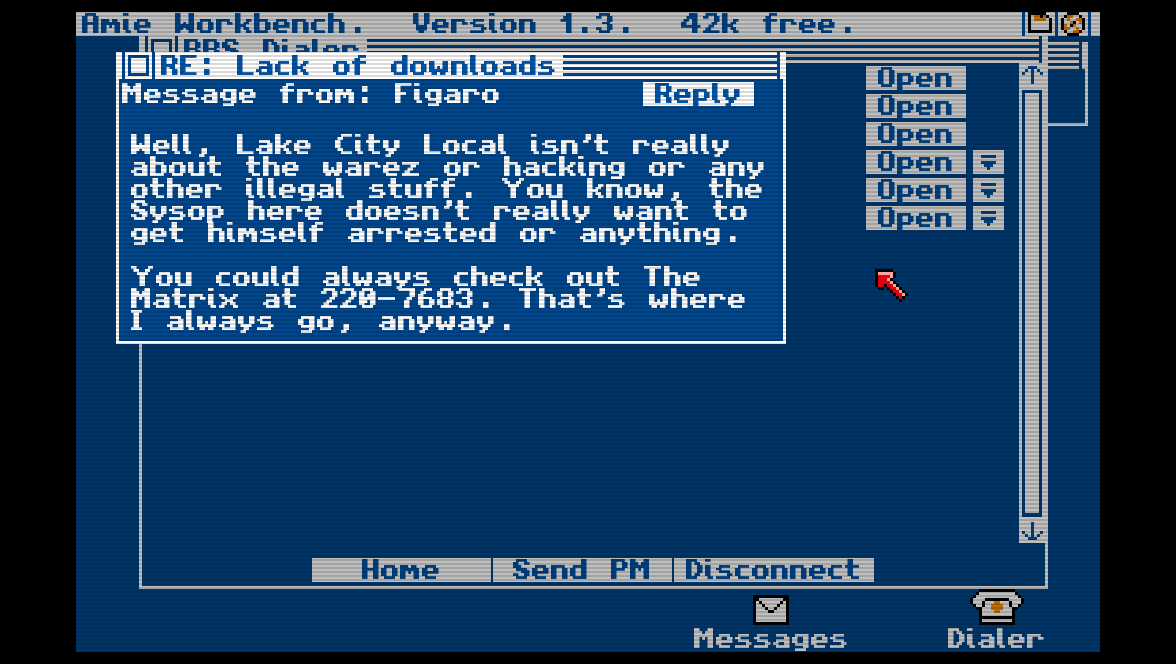
“Reading a message on a board in DALS. Gotta find that warez!”
First, the entire BBS experience is extremely dumbed down. You dial a BBS and are treated to a welcome screen that looks more like a BBS advertisement (though this isn’t totally inaccurate – such welcome screens weren’t uncommon.) You then need to logon, which requires only a password and not actually a username, oddly. From there, all you can really do is read and reply to public messages and send private message the users on the BBS. The whole experience is very simple, reminding me a lot of the BBSes in Interplay’s Neuromancer adaption (which I reviewed years ago here.) It absolutely gets the job done in terms of gameplay though, and I think some abstraction is probably necessary, but regardless, these BBSes only barely resemble the real thing.
It’s all a little anachronistic too. The game’s intro/title screen is based on the Commodore 64, yet the rest of the game’s interface is based on Amiga Workbench 1.x. The fonts, music, graphics; none of it quite adds up. It’s even mouse driven, though this is somewhat forgivable as even though BBSes weren’t generally mouse based, basing the game’s interface on a mouse driven OS made this seem much more plausible. Despite these nitpicks, it’s effective enough in my mind. I mean, if someone like me could get immersed in it, it’ll surely work on someone less familiar with the tech.
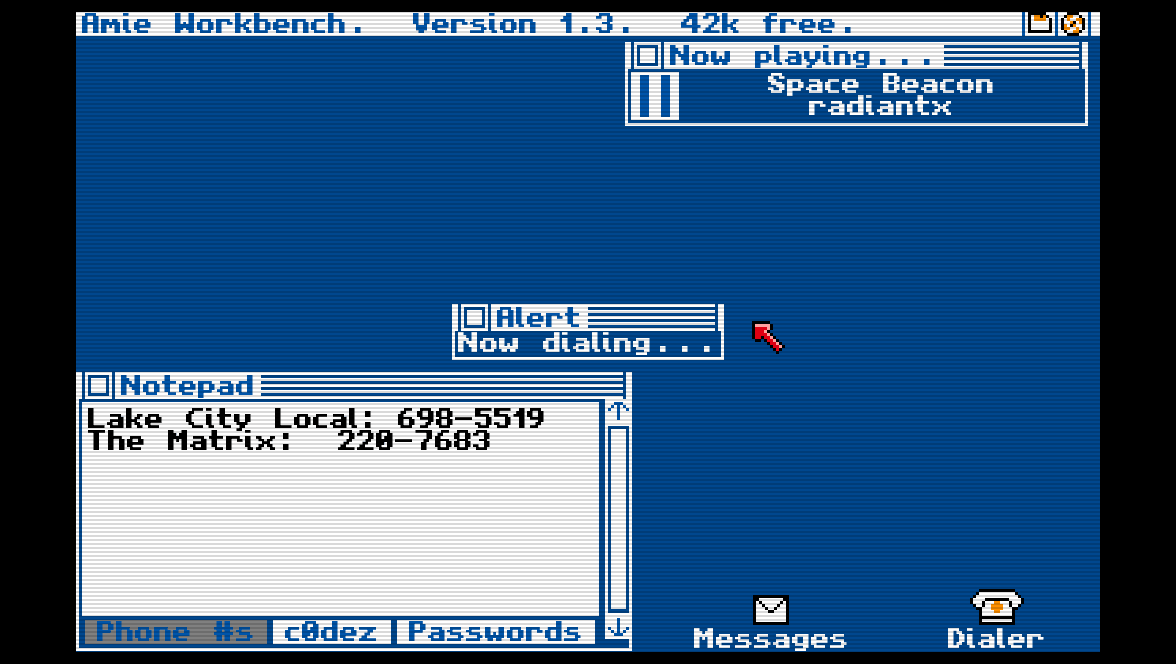
“Calling the new board I was just recommended.”
Disappointingly, despite how absolutely crucial communication via messages is to the gameplay, you don’t actually get to see the messages your character writes. While I didn’t expect you to be able to free-form write messages yourself, you don’t even get to see what your character wrote. Instead, it’s only hinted at by the subject lines of the messages people are replying to. Kind of weird, but it’s also sort of cool that it leaves the contents of the messages open to interpretation. Given that your character is also kind of a tabula rasa, that’s probably for the best. That said, as mentioned, this is actually a visual novel, not some kind of slick hacking simulator, so the fact that it’s even this functional is remarkable.
Unfortunately the gameplay starts to feel repetitive quite quickly, as it mostly just involves dialing a BBS, reading and replying to messages, logging off, and moving on to the next board. Sometimes it’s not clear where you need to call next, or how to get into a system, but overall it’s all fairly simple. With a time to beat of around 2 hours, I appreciate that it doesn’t quite overstay its welcome either. Still, I would have personally liked to see more tension here. What I mean by that is that a big part of BBSing back in the day was having to wait hours, maybe even days to get a response to a greatly anticipated message, or for your daily allowance of time, game turns, or download credits on a particular board to reset, but none of that is really represented here.
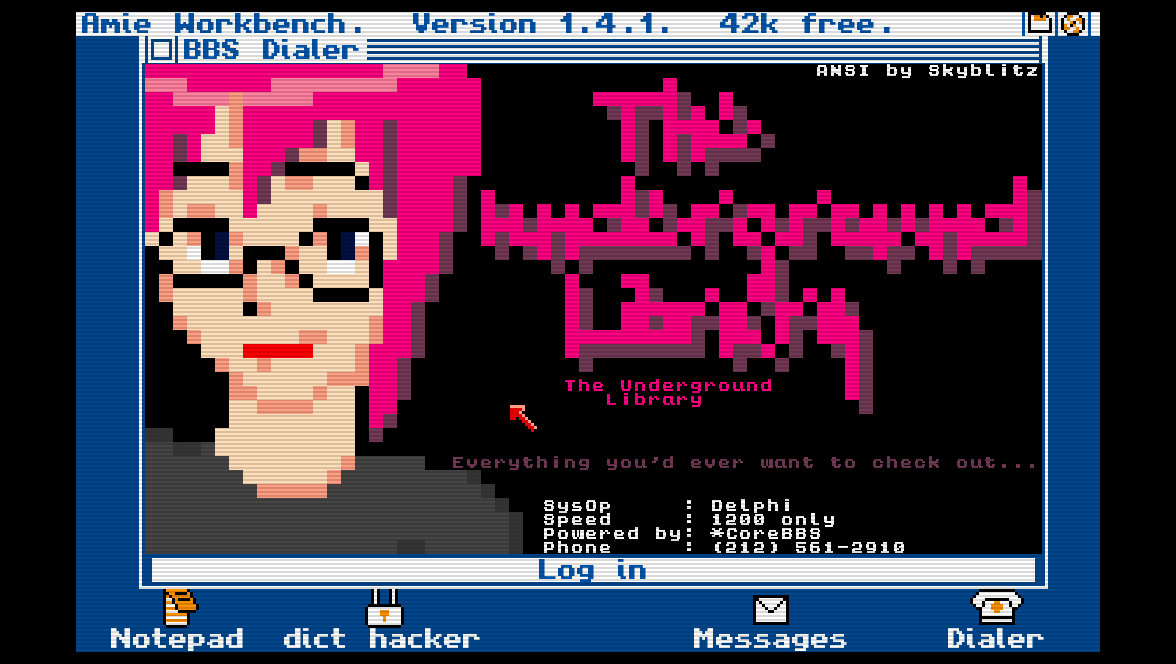
“Sweet welcome screen, though that’s not quite ANSI.”
Surprisingly, I think where the game really stumbles is the story itself. Before playing it I imagined a really involved, lengthy narrative as the main character starts to befriend various people on these BBSes, perhaps build a reputation of sorts, and the romantic relationship referenced by the title blossoms. Instead, it all feels fairly surface level, especially the relationship, which progresses incredibly quickly to the point that I barely felt much towards the character you have this relationship with. It all feels a little rushed and shallow as a result. Beyond that, it cribs from Gibson pretty hard, but then, what good cyberpunk story doesn’t?
Digital: A Love Story is available for free from the author’s website, so if any of this sounds interesting to you, I’d recommend giving it a shot. There are much worse ways to spend two hours.
Speaking of slick hacking simulators, Introversion’s Uplink is just that, and really, one of the progenitors of the entire modern genre. After playing Introversion’s WarGames inspired global thermonuclear war focused light strategy game Defcon, I briefly became quite intrigued by Introversion Software and their innovative, stylish, often somewhat toy-like games that remind me of highly evolved products of the same underground computer scene I came up in. This is when I bought Uplink and a few other games of theirs, though somehow, despite thinking it looked awesome, I never actually got around to trying it.
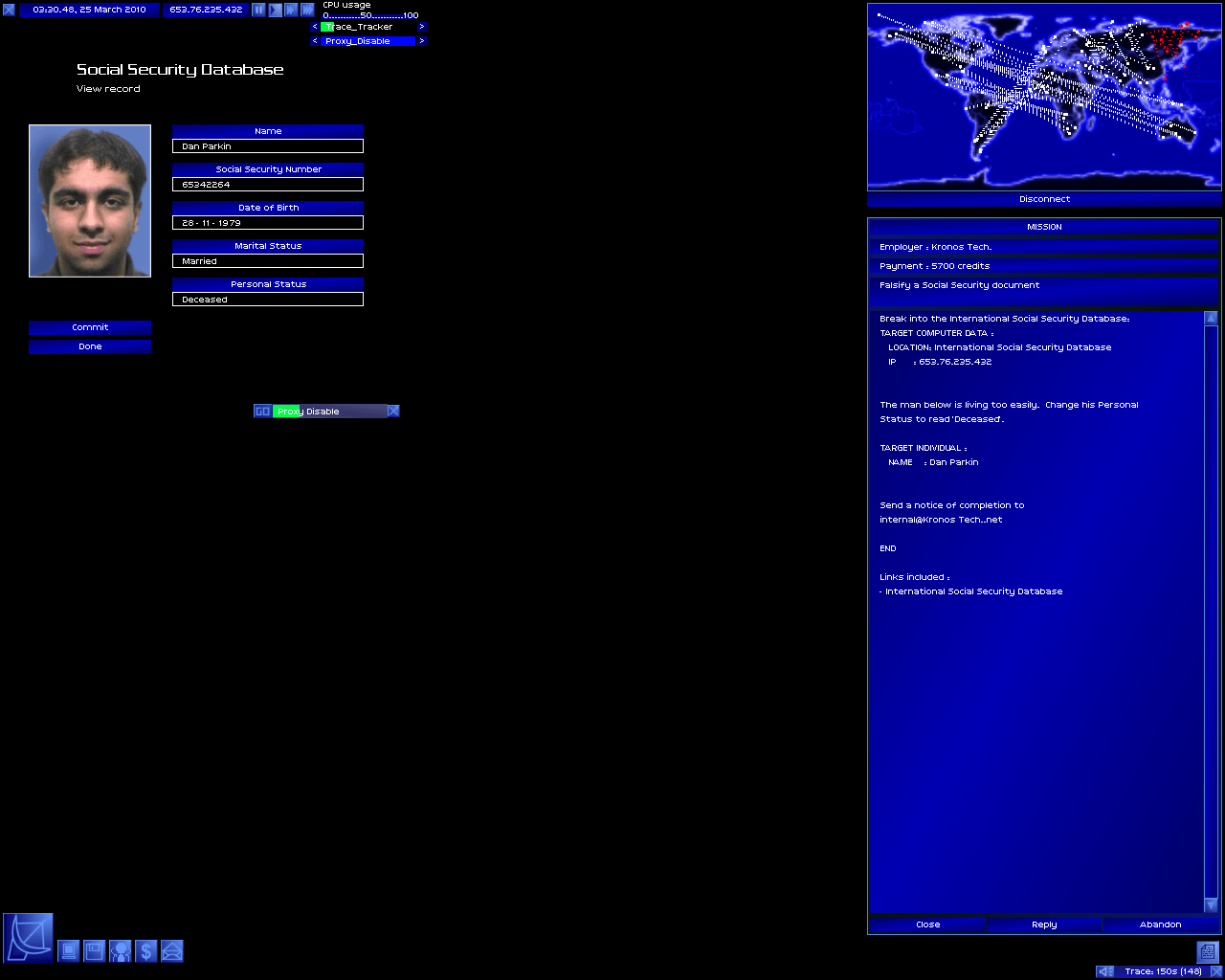
“Killing my boy Dan in the original Uplink. Sorry, bud!”
Uplink takes place in some presumably cyberpunky version of (then future) 2010 in which you sign up with the Uplink Corporation as a freelance hacker. Through them you take on jobs/missions, monitor relevant news articles, update your software tools, and upgrade your gateway computer – something of a “jumpbox” that you do all of your nefarious deeds through. Once you have one or more missions, you’re emailed a more detailed description of your objective including the name and IP address of the server you need to carry them out with. You’ll need to connect to the server, but oh no, not directly, as you’d be traced and caught in no time. Instead, you’ll need to bounce your connection through multiple intermediary servers to increase the time it takes to trace you. It also helps if at least one of them is a server you can easily gain admin access to so you can clear the logs of your connection being routed through it to break that chain, as it were.
From there, things only get more complex. Some missions have you deleting files, some have you downloading and emailing files, sometimes needing to decrypt them first. Sometimes you’ll need to hack an institution to view or change some records, or move some money around, and sometimes you’ll need to trace someone else’s bank transfers, or even track down a rival hacker. The more difficult missions require a complex series of subtasks, and some may even have time limits. The mechanisms you need to work around are more difficult too. At first, just using a cracker to brute force an admin password is good enough. Later on, you’ll need to break encryption keys, provide voice imprints, and maybe even route your connections through other company servers. Sometimes you’ll need to disable monitoring servers, proxy servers, and firewalls too.
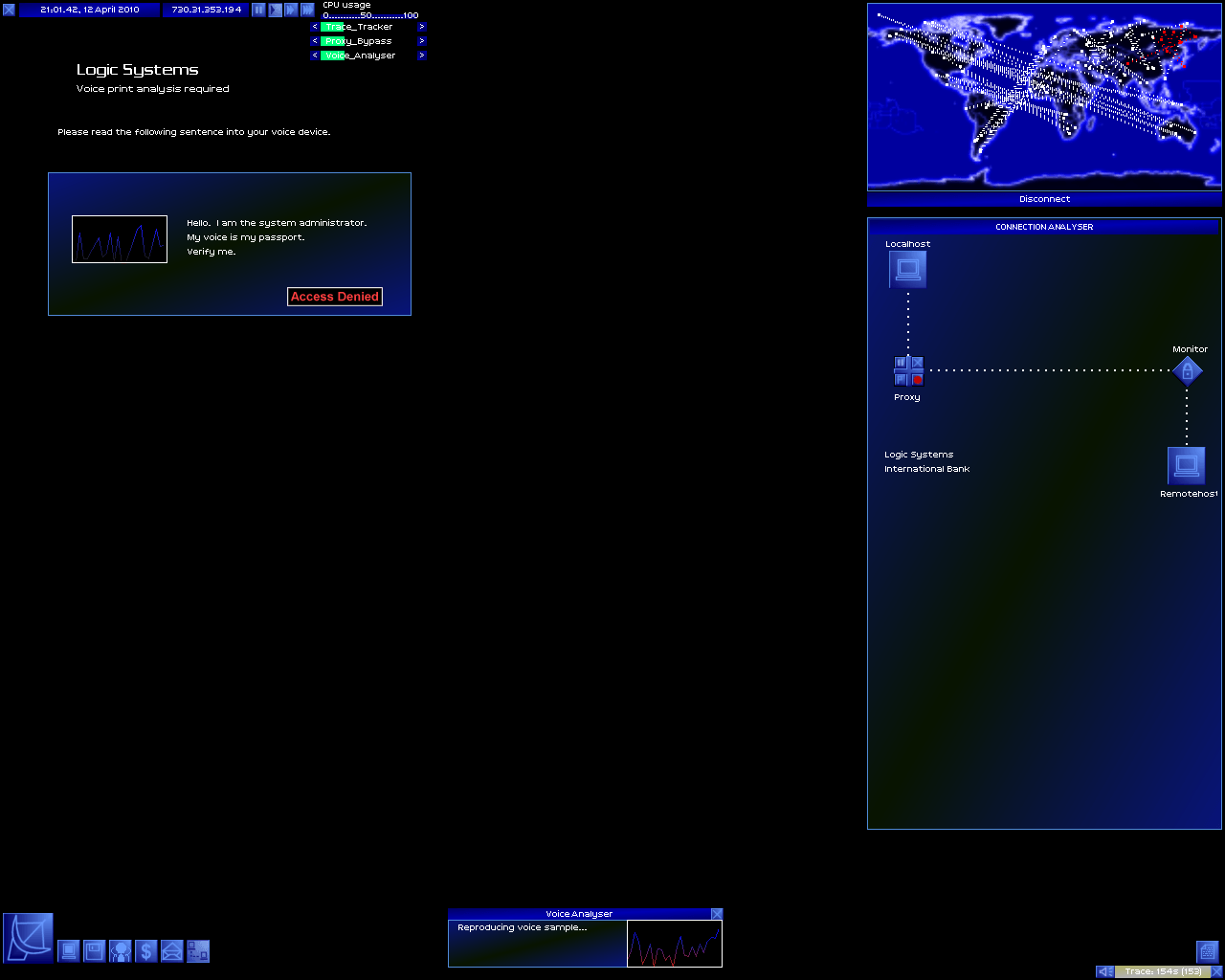
“Providing a voice sample to work my way into this Logic Systems server.”
The variety and complexity of these tasks ties smartly into the game’s progression system. Each level of mission gives you more and more cash, which lets you buy new software tools, update old ones, and upgrade your gateway’s hardware, allowing you to handle higher tier missions, which grant you even more money. Repeat! At least, that’s how the game is meant to be played. A cheeky strategy I found a lot of references to online is to hack a bank early on to give yourself a massive injection of funds and shortcut a lot of this progression. Of course, you’ll still need to gain experience to have higher level missions available to you, though having all of the best tools and the fastest hardware would certainly make that easier.
Regardless of how you get there, this all culminates as you reach the hardest missions, which often require gaining access to a corporate LAN and mapping out and hacking every server in the network to reach your target. Each hack may require bypassing multiple of the above mentioned roadblocks, and you’ll have an admin aggressively chasing you at every step too. Fun!
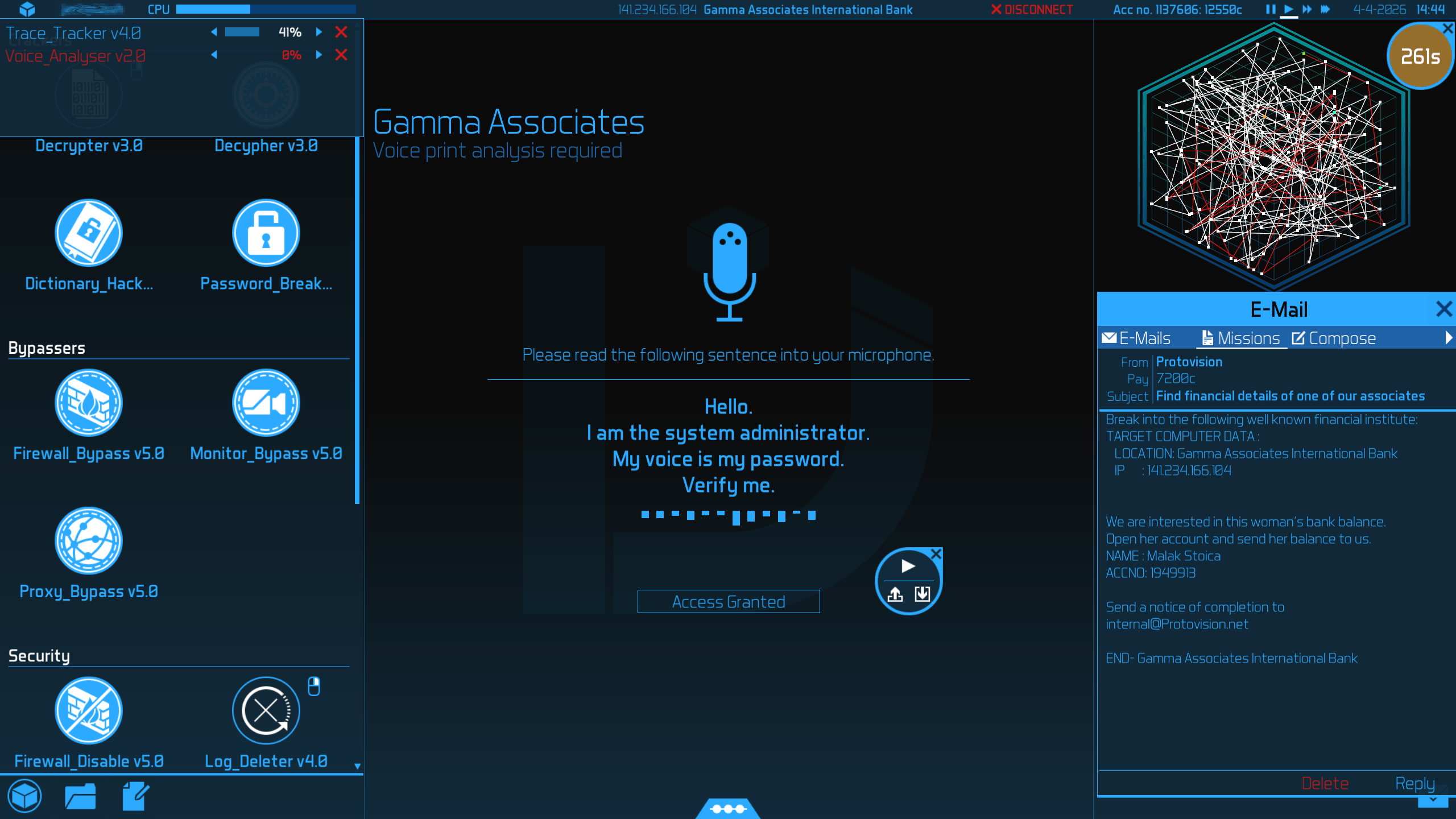
“Providing a voice sample, but this time in the Uplink OS mod.”
One of the best things about Uplink, and honestly, all the best entries in this genre, is that it is quite immersive. You’re interacting with a virtual computer system of some sort, and given that you’re actually interacting with a real computer system of some sort to play the game, it’s not a massive leap to feel like you’re actually really doing something. Couple this with the realistic sense of isolation you experience playing a single character in first person (narratively speaking) staring at a somewhat open-ended GUI and/or a blinking cursor at a CLI prompt, with your only contacts being an occasional email or chat message. If you’ve ever been there yourself, and I’d wager most of us have in one way or another, it’s extremely effective.
Uplink suffers some here in that it was developed and released in the early 2000s. It still has a lot of now anachronistic references to “dialing into” servers and its GUI, while looking like a slick Window Manager you might have used with X back in the day, is a little clunky by today’s standards. Text boxes need to have their default text manually cleared, and have other weird input limitations, for example. The game also doesn’t handle modern screen resolutions very well, either. Thankfully, there are mods for all of that, some of which I almost hesitate to call mods as they replace the entire executable becoming what is more or less a whole new client for the game. The most popular of these is probably Uplink OS. I would highly recommend anyone looking to play Uplink these days just go ahead and start with something like Uplink OS, though with the caveat that you know that some of these UI and seemingly minor gameplay enhancements actually heavily affect the gameplay itself. That, and in Uplink OS’s case, even the aesthetics are quite different. While I prefer some elements of the original Uplink, Uplink OS was clearly a labor of love and its benefits outweigh its negatives in my opinion.
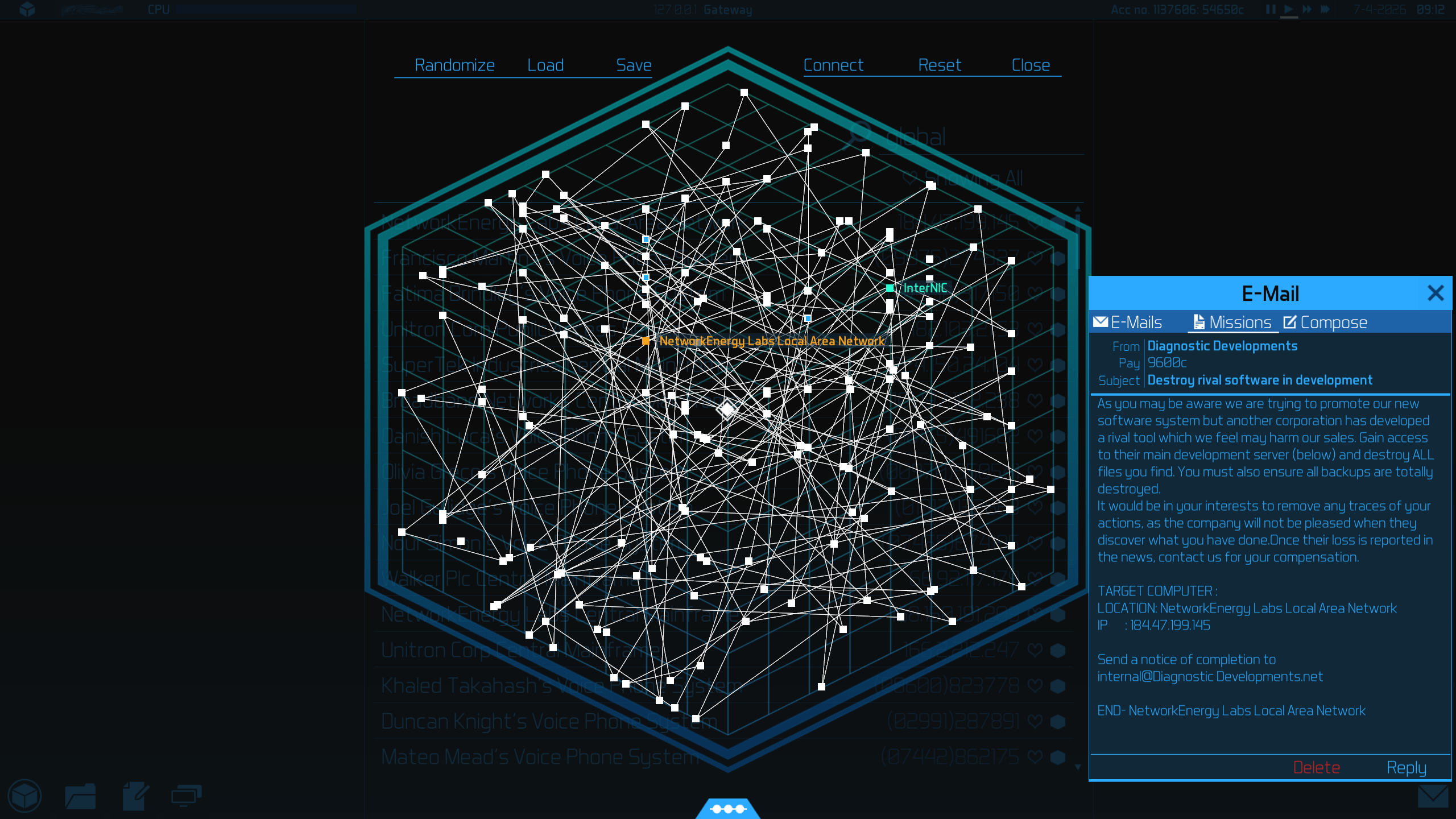
“Uplink OS replaces the world map with a boring hexagon, but I love the Randomize button!”
I started off with the original Uplink and didn’t find it too annoying to work around the UI and technical imitations of it, but at some point, maybe 10 hours in, I found myself almost hard locked from proceeding any further: I needed money to purchase some tools to do the new mission types at my current level, but had exhausted all of the lower tier missions I could actually handle. This is, admittedly, totally my own fault for not managing my funds better, but hey, this seemed like a good time to check out Uplink OS. Making a new character and being much more methodical this time (thanks to understanding the game a lot better) paired with a much more responsive UI, meant progression was waaaaay faster. Unfortunately I made another silly mistake. I was learning the ins and outs of hacking LANs when I finally completed my mission and increased the game speed to wait for the news to report on my deeds. Instead, I received my first game over screen – busted! This wasn’t really game over, but I essentially would need to work my way up from zero. As much as that sucked, I was much more annoyed by not knowing how I could have been caught. Regardless, having put probably 25-30 hours into Uplink, I’d have probably thrown in the towel if I hadn’t sneakily backed up my local save file at some point before this.
With that, I decided to change focus. When you make it far enough into the game, you start being offered missions out-of-band, which lead to a more linear set of special missions. With my second playthrough going so fast, I never got to the calendar date in which the first of these missions would be offered to me, so determined to beat the game legitimately at least once, I restored my game, did a few more missions to get a little more cash, then put the game’s clock on fast forward. At a high level, the story consists of two corporations vying against each other: one that wants to destroy the Internet because they feel like it has become corrupted by government and corporate control from its once great position as a bastion of free speech, while the other would rather, you know, NOT destroy the entire Internet. Of course, you’re able to choose either side, or ignore the entire thing (although that may eventually turn out badly for you if things have already been set into motion.) Personally, I chose Arunmor because at first ARC’s motives seemed more anti-social, plus being a professional hacker, my character would be out of work if the Internet were to cease to exist. I’m nothing if not practical!
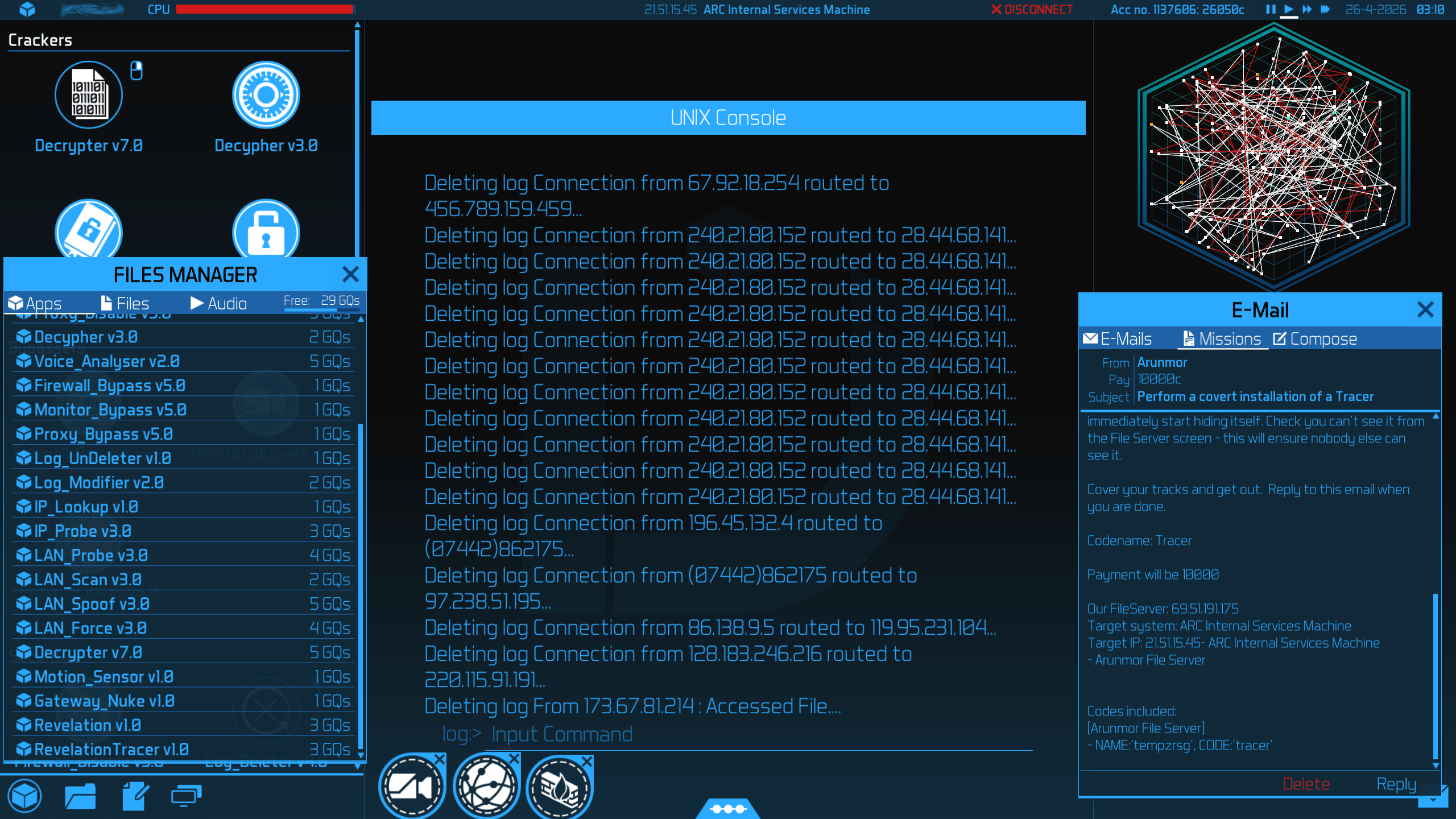
“Deleting a system’s logs via CLI to cover my tracks.”
That said, the story feels a little rushed and could have perhaps used a bit more drama, even if just in the form of more emails, news articles, and other text, but I do appreciate how there are a lot of little clues about this whole plotline sprinkled throughout the game. More of this would have made the story that much better, though. As for the story missions themselves, beyond the new mechanics introduced by the Faith vs Revelation viruses, they utilize a little bit of everything you’ve learned up to this point. It’s a simple but smart design, and my final mission for Arunmor, which involved racing against the spread of the Revelation virus, was surprisingly tense.
Perhaps one day I’ll return to follow the ARC storyline, but for now I’m ready to move on to something else. In any case, Uplink is a bona fide classic. I’m looking forward to seeing how other games have attempted to evolve the formula, however.
I remember hearing a lot about Her Story when it was released back in 2015. It seemed like everyone was playing it, but I didn’t know much about it apart from it supposedly being one of the more impressive entries in a wave of FMV revival games. I knew it involved watching a lot of video clips, and that was about it. So what does it have to do with this theme?
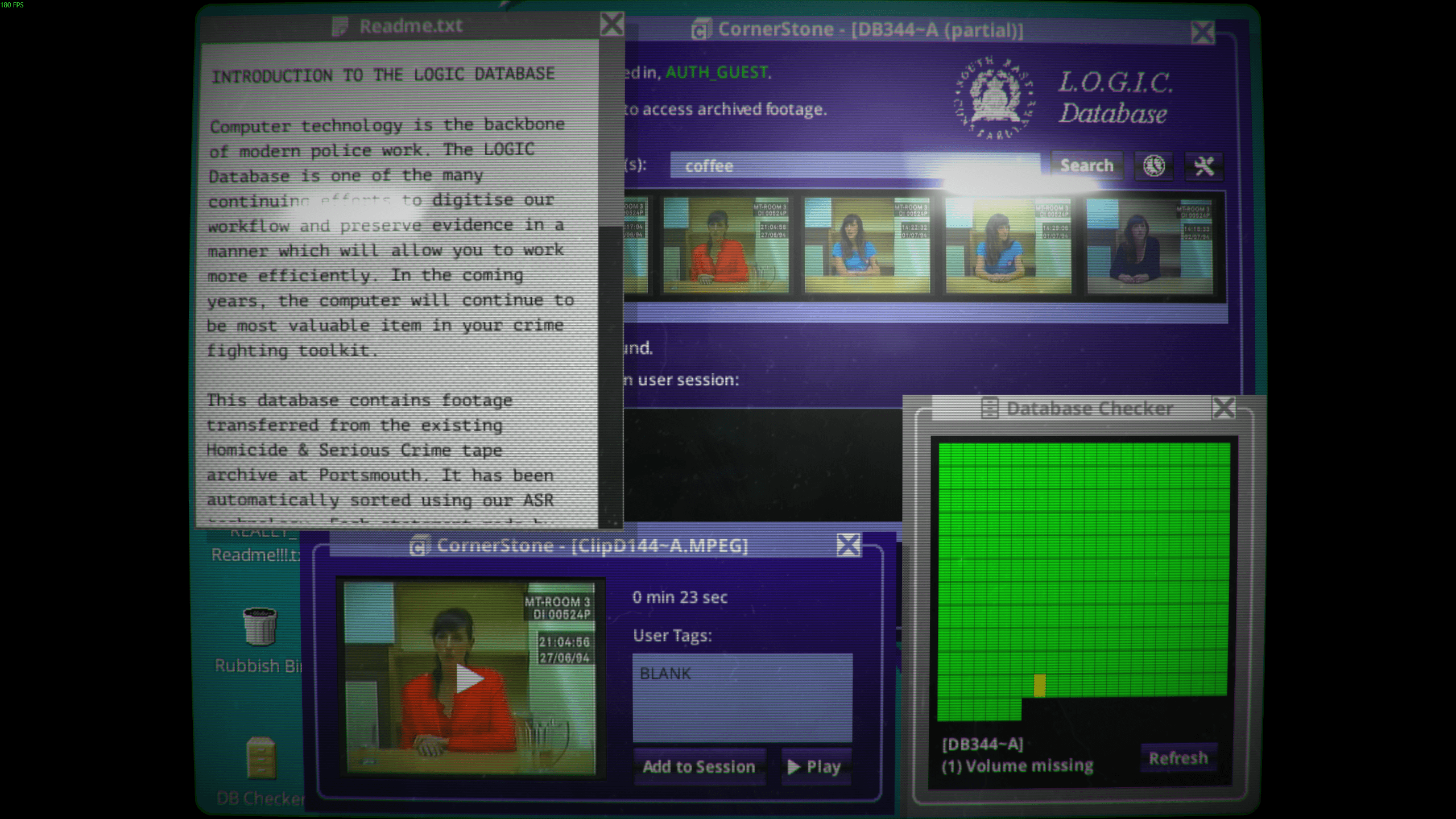
“Making my screen a little cluttered to show off the UI in Her Story.”
Her Story puts you in the role of some kind of an investigator who is placed in front of an old PC with access to a curated archive of police interview footage. The interviews focus on a single person, Hannah Smith, the wife of a man found dead in their home, seemingly murdered. You’re not given much in the way of background on who you are, why you’re reviewing this data, or what your goal really is. One would assume you’re a detective, and you’re trying to determine the details of the murder, including whether or not Hannah is guilty or at least a legitimate suspect. Almost all of the interaction in Her Story involves typing simple search queries into this video database application and reviewing the results. Mostly this is in the form of keywords and phrases, but you can also add your own tags to individual clips, which is pretty neat. One interesting aspect of this is that each search will only let you see the first 5 results, which means narrowing down and refining your searches is practically a requirement, especially if you want to try turning over every last stone.
The simulation here is surprisingly competent for a game that, well, isn’t really about that. The machine you’re in front of is modeled after Windows 95 and you’re able to interact with it with a reasonable amount of fidelity – there are multiple programs you can open, including a little game that someone had apparently tried to delete, you can move windows around, etc. Probably the most interesting aspect of this is the “glare” effect which adds a not-at-all subtle CRT effect to the screen – scan lines, a slight curve to the picture, dust on the screen itself, and reflections in the form of the fluorescent lights behind you, occasional lights from passing police cars, and even your own character’s reflection at times. This is the type of feature that a lot of people might immediately turn off, but I’m personally really fond of Her Story’s implementation of it, and I feel that it does just as much to set the mood as the ambient soundtrack in the background.
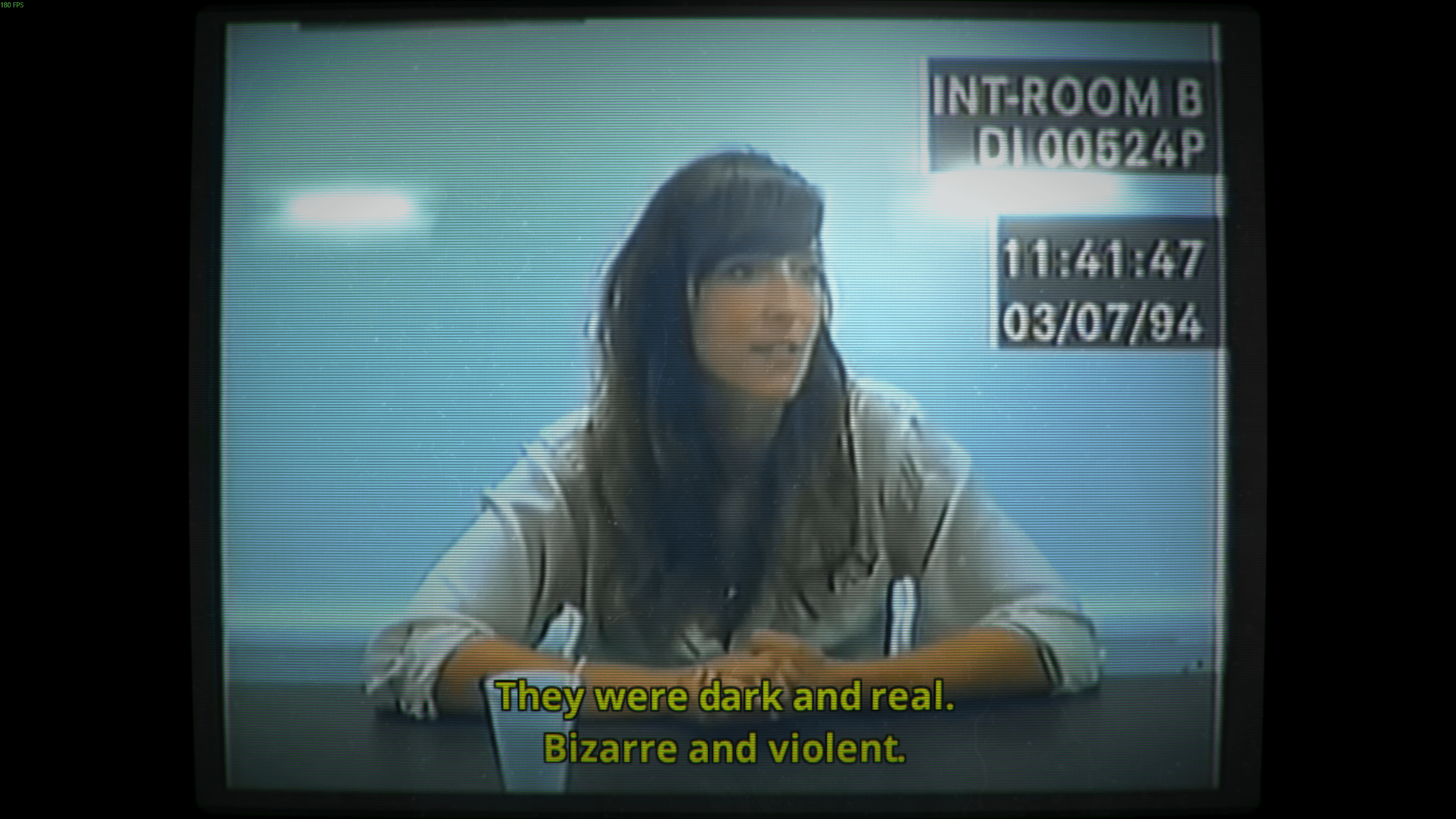
“Hannah tells us about her favorite video games.”
What really intrigued me about Her Story was the mysterious nature of many of the details of the story, both those expected (the obvious “whodunit?” of it all) and perhaps surprising. I obviously need to tip-toe around potential spoilers here, but the biggest mystery is in regards to Hannah’s identity. Is she who she says she is? It’s blatantly clear that there is some kind of manipulation going on, but it seems as if the game goes to lengths to specifically throw you off the scent, tossing out hints to support and oppose both of the two main conclusions you’re likely to draw. Personally, I went with the… err, let’s say “same person” conclusion myself due to some phrasing that is used here and there and some of the overall manipulative behavior observed, though I later watched a video on YouTube that convinced me that the other option was probably correct. Regardless, the game purposely leaves a lot of this, a lot of everything, open to interpretation. In fact, before I was even 50% through the archive I thought I had a fairly good idea of what happened, but with no idea how I was supposed to “beat” the game. While that becomes more clear eventually, the game ends without answering many of these questions, and a detail given at the very end still managed to surprise me while re-framing a few things at the same time.
It’s short, despite clocking in at a few hours tops, and it’s minimally interactive for a “game” to boot, Her Story’s execution really worked for me, and its story is one that I won’t forget any time soon. Part of this is thanks to the performance of Viva Seifert, but I also want to seek out more of Sam Barlow’s games, including Telling Lies, which is something of a spiritual successor to Her Story and includes a similar style of gameplay, which means it might end up in a future installment of this series.